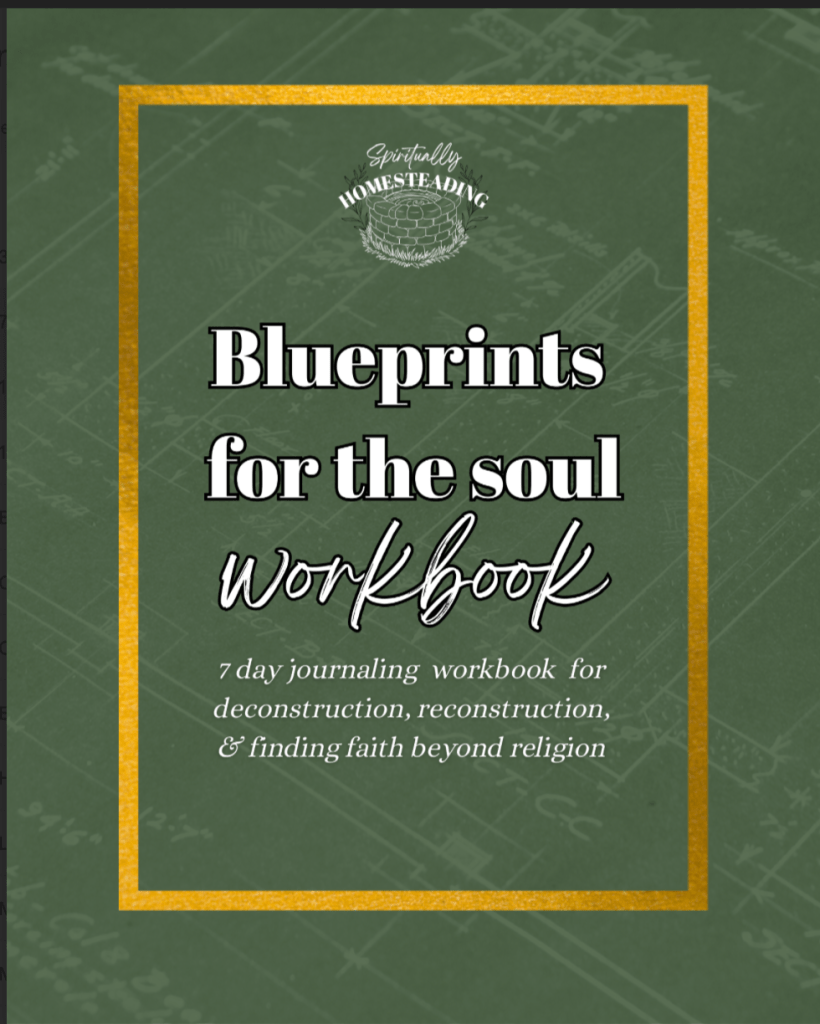
FREE 7 Day Deconstruction to Reconstruction Workbook & Journal, while copies last!

Understanding the process of questioning your faith without fear
If you’ve been hearing the term “deconstruction” thrown around in Christian circles and wondering what it really means, you’re not alone. There’s a lot of confusion (and unfortunately, fear) surrounding this concept.
Some Christians view deconstruction as something dirty or dangerous, even labeling it as a liberal agenda designed to destroy the church and God. But that is not what deconstruction is at all.
What is Deconstruction? The Real Definition
Deconstruction is a philosophical term coined in the 1960s by French philosopher Jacques Derrida. Originally appearing in literary theory, deconstruction is essentially the process of trying to arrive at the truth of things while recognizing that absolute definitions are more complex than we often assume.

Here’s a simple way to understand it: We often define things by what they’re not. A fork is a fork because it’s not a spoon. We tend to categorize everything in black and white terms: you’re either a Christian or you’re not. To some to deconstruct your faith means you are either a believer or you aren’t.
However, Derrida realized that knowledge and information are far more complicated than humans assume they are. Deconstruction wasn’t created specifically for Christianity; it’s simply a term that people use when they’re examining their faith and asking important questions.
Faith Deconstruction: What Does It Mean for Christians?
When applied to faith, deconstruction means taking an honest look at your beliefs and asking:
- How much of what I believe is actually real or assumed “truths”?
- How much have I simply inherited from people I thought were trustworthy?
- What is actual theology and doctrine versus human-created systems?
This is not a bad thing. In fact, you could argue that many of our different denominations exist because people throughout history have been deconstructing their faith. (i.e. Martin Luther and his 95 Theses)
Philosophers and theologians are essentially deconstructionists. They take ideas, compare them, and analyze them. Think of it like a Rubik’s cube. If information is the Rubik’s cube, deconstructionists are constantly rotating it, trying to get everything aligned to understand it better.

Why Deconstruction Isn’t Something to Fear
If you’re someone wrestling with your faith, don’t be afraid of the term deconstruction or the process itself. Here’s why it’s actually healthy:
1. It Shows You Care About Truth
When you deconstruct, you’re saying: “I recognize that I have a relationship with God (or want to have one, or I’m not sure), and it’s important for me to figure out who God actually is, what I believe about Him, and what is truth versus just passed-down information from humans.”
2. It Helps Separate God from Human Systems
Many churches and institutions have created systems, policies, and procedures that aren’t necessarily biblical—they’re just how those particular organizations do things. Just like there are multiple forms of government (democracy, socialism, theocracy), there are different ways to structure religious practice. Some are better than others, but the structure isn’t necessarily the essence.
3. It’s a Sign of Spiritual Maturity
Asking “What is faith? What is the idea of faith?” shows spiritual growth and a desire for authentic relationship with God rather than blind adherence to tradition.
Deconstruction vs. Deconversion: They’re Not the Same
One important distinction: deconstruction is not the same as deconversion. We often fall into either/or thinking—either you’re following along with what everyone else is saying, or you’re trying to become an atheist. The truth usually lies somewhere between those two extremes.
Figuring out what you actually believe is one of the healthiest things you can do for your spiritual journey and practice.
How to Approach Faith Deconstruction
The process of deconstruction involves several key steps:
- Ask honest questions about your beliefs
- Examine inherited assumptions versus personal convictions (We will be talking about this on Podcast Episode #12)
- Distinguish between essential faith elements and human-created systems
- Seek truth rather than comfort or familiarity
- Be patient with the process—it takes time
Final Thoughts
Deconstruction isn’t about tearing down your faith—it’s about examining it honestly so you can build something authentic and lasting. Don’t let fear of the term or the process keep you from asking the important questions that could lead to genuine spiritual growth.
Your willingness to wrestle with these questions shows courage and a sincere desire for truth. That’s something to be proud of, not ashamed of.
Are you walking through faith deconstruction? What questions are you asking in your journey? Remember, seeking truth is always worth the effort, even when the process feels challenging.
Have you seen the free 7 Day Deconstruction to Reconstruction guide here.

 Laura farhy
Leave a comment